
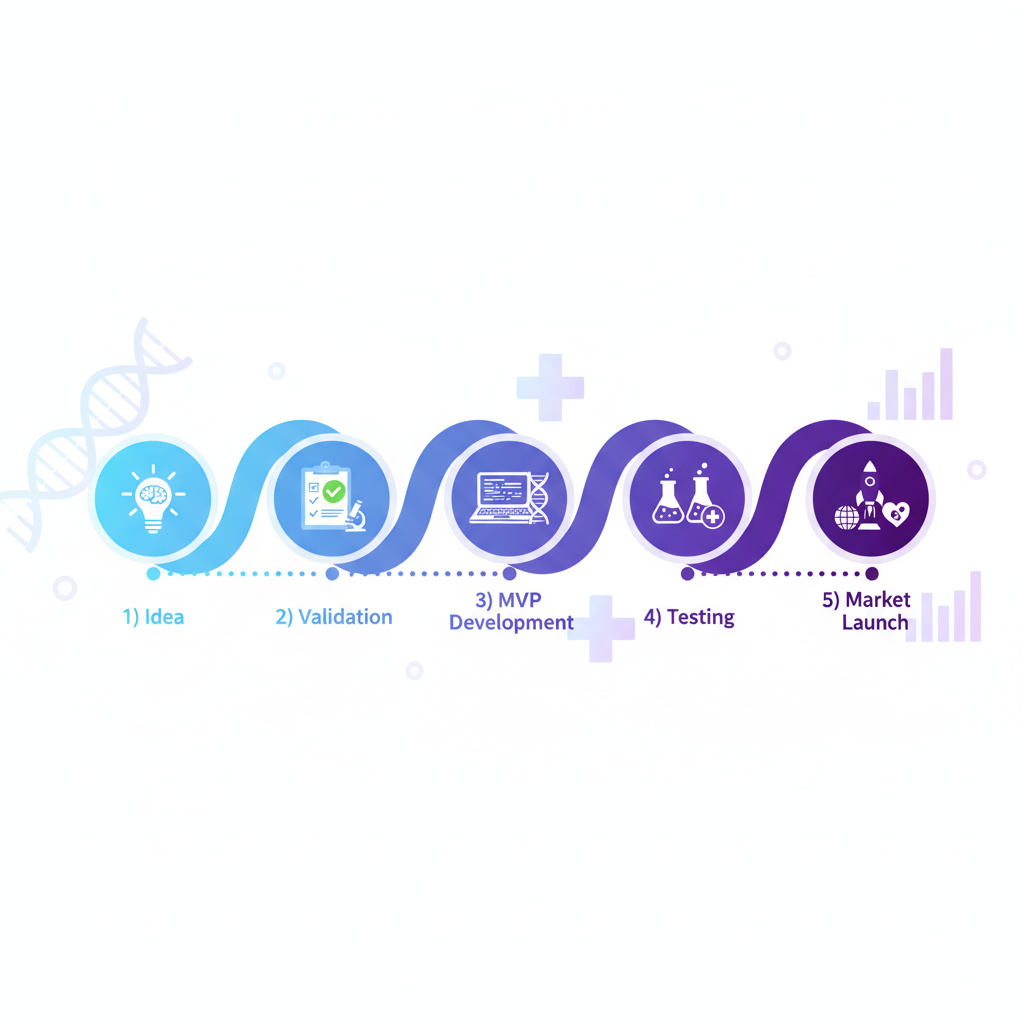
Introduction: The Life Science Software Journey
Have you developed an innovative idea for medical software, but don't know where to start? You're not alone. Many life science entrepreneurs face the same question: How do I bring my idea to a market-ready, CE-marked product?
Life science software development is fundamentally different from general software development. Regulatory requirements, patient safety considerations, clinical validation, and extensive documentation transform what might be a 6-month project in other sectors into an 18-36 month journey.
Denmark offers a strong innovation ecosystem for life science startups. With world-class universities (SDU, DTU, AAU), biotech clusters in Funen and Copenhagen, supportive funding programs (Innovationsfonden), and proximity to leading hospitals willing to collaborate, Danish medtech startups have unique advantages.
This comprehensive guide walks you through every stage from initial concept to market launch, with realistic timelines, cost estimates, and actionable advice based on 10+ years of experience developing life science software in Denmark.
Stage 1: Idea Validation & Market Research
Before writing a single line of code, validate that you're solving a real problem for a real market.
Problem Definition
Start by clearly identifying the problem you're solving:
- What specific pain point exists in healthcare or life science?
- Who experiences this problem? (patients, clinicians, researchers, pharma companies)
- How significant is the problem? (frequency, severity, cost)
- What are current workarounds and their limitations?
User Research in Healthcare Settings
Healthcare user research presents unique challenges due to regulatory and privacy constraints. Methodologies include interviews with clinicians, observation in clinical settings (with appropriate approvals), surveys of healthcare professionals, and documentation for regulatory purposes (user needs file).
Danish resources: SDU Health Innovation Centre, DTU Bioengineering, and collaboration with hospitals like OUH (Odense University Hospital), AUH (Aarhus University Hospital), and Rigshospitalet.
Market Size Analysis
Quantify your market opportunity:
- TAM (Total Addressable Market): All potential users globally
- SAM (Serviceable Addressable Market): Realistic market you can reach
- SOM (Serviceable Obtainable Market): What you can capture in 3-5 years
Example: 20 Danish hospitals × 200,000 DKK average budget = 4M DKK/year Danish market. Expand to Nordic countries: 40M DKK/year potential.
Regulatory Classification
Critical question: Is your software a medical device under MDR? This determination dramatically impacts timeline and cost.
- Does software diagnose, treat, prevent, or monitor disease?
- YES → Medical Device (likely Class I, IIa, IIb, or III)
- NO → General software (still requires GDPR compliance)
Contact Lægemiddelstyrelsen for classification confirmation. Use MDCG guidance documents for self-assessment.
Timeline: 1-3 months
Cost: 25,000-75,000 DKK (user research: 15,000-30,000 DKK, market analysis: 10,000-25,000 DKK, regulatory consultation: 0-20,000 DKK)
Stage 2: Concept & Prototyping
Transform validated ideas into tangible designs that users can interact with and evaluate.
Requirements Gathering
Document comprehensive requirements:
- Functional requirements (what features?)
- Non-functional requirements (performance, security, usability)
- Regulatory requirements (if medical device)
- User requirements (from Stage 1 research)
Use user stories format: "As a [clinician], I want to [view patient trends], so that [I can adjust treatment]."
User Personas for Healthcare
Develop detailed personas covering:
- Primary user (e.g., cardiologist)
- Secondary users (e.g., nurses, patients)
- Tertiary users (administrators, IT staff)
Wireframing & UX Design
Healthcare UX principles:
- Minimize cognitive load (clinicians are busy!)
- Clear information hierarchy
- Error prevention for critical actions
- Mobile-friendly (many clinicians use tablets)
- Accessibility (WCAG 2.1 AA minimum)
Interactive Prototype Development
Create non-functional prototype (Figma, InVision, Adobe XD), conduct usability testing with 5-8 target users, iterate based on feedback, and document usability testing (required for medical devices).
Technology Stack Selection
Consider regulatory implications, team expertise, scalability, and SOUP (Software of Unknown Provenance) management. Popular choices:
- Frontend: React, Angular, Vue.js
- Backend: Node.js, Python (Django/Flask), .NET
- Database: PostgreSQL, MongoDB, MySQL
- Cloud: AWS, Azure, Google Cloud (prefer EU regions for GDPR)
- Mobile: Flutter (cross-platform), React Native
Timeline: 2-4 months
Cost: 75,000-150,000 DKK (UX design: 40,000-80,000 DKK, prototype: 30,000-60,000 DKK, usability testing: 5,000-10,000 DKK)
Stage 3: MVP Development
In life science, MVP means Minimum Viable Product with emphasis on "Viable" - safe, effective, and compliant from day 1.
What is an MVP in Life Science Context?
Traditional Silicon Valley MVP: Minimal features, ship fast, iterate, "fail fast" mentality.
Life Science MVP: Minimum features for clinical utility, Viable means safe and compliant, Product ready for pilot testing (not full launch), Quality and documentation from day 1.
Key difference: You can't "move fast and break things" when patient safety is at stake.
Core Feature Prioritization
Use MoSCoW method:
- Must Have: Core functionality for primary use case
- Should Have: Important but not critical for pilot
- Could Have: Nice to have if time/budget allows
- Won't Have: Future releases after market validation
Quality Management from Day 1
If your software is a medical device, implement quality management system (QMS) from the start:
- Design controls (input, output, verification, validation)
- Risk management per ISO 14971
- Requirements traceability
- Change control processes
- Documentation (SRS, SDS, Risk Management File)
Agile Development with Compliance
Agile and regulatory compliance are compatible with proper integration:
- 2-week sprints within design phases
- Definition of Done includes QMS requirements
- Continuous integration with automated testing
- Living documentation in Confluence/Notion
- Quarterly design reviews for certification bodies
Testing Strategy
- Unit testing (aim for 80%+ coverage)
- Integration testing
- System testing against requirements
- Usability testing (formative)
- Security testing (penetration testing)
Timeline: 4-8 months
Cost: 300,000-800,000 DKK (development: 250,000-650,000 DKK, QMS implementation: 50,000-150,000 DKK)
Stage 4: Regulatory Preparation & Compliance
If your software is classified as a medical device, prepare comprehensive regulatory documentation for CE marking.
Technical Documentation
Complete technical file required for MDR compliance:
- Device description and specifications
- Design and manufacturing information
- Risk management documentation
- Verification and validation
- Clinical evaluation
- Instructions for use (IFU)
Validation Documentation
- Validation protocol
- Validation report with test results
- Traceability matrix (requirements → tests)
- Summative usability evaluation
Notified Body Selection (Class IIa/IIb/III)
For Class IIa and higher, you need a Notified Body to review and certify your device. Popular choices in Denmark/Europe: TÜV SÜD, BSI, DNV GL, SGS, DEKRA.
Timeline: 3-6 months (Class I), 6-12 months (Class IIa/IIb)
Cost: 100,000-500,000 DKK (technical documentation: 50,000-200,000 DKK, Notified Body fees: 50,000-300,000 DKK)
Stage 5: Funding & Investment
Life science startups require significant capital. Danish funding landscape offers multiple options.
Danish Funding Sources
- Innovationsfonden: Up to 10M DKK for innovative projects
- EU Horizon Europe: Large-scale grants (1-5M EUR)
- Vækstfonden: Venture loans and co-investment
- Pre-Seed Ventures: Early-stage funding (1-3M DKK)
- Business angels: Healthcare-focused investors
- VC funds: Nordic medtech VC firms
Pitch Deck Essentials
- Problem: Clear pain point with evidence
- Solution: Your software and unique value proposition
- Market: TAM/SAM/SOM with realistic projections
- Traction: User testing results, LOIs, pilot agreements
- Regulatory: Classification, timeline to CE marking
- Team: Healthcare and technical expertise
- Financials: Revenue model, 3-year projections
Timeline: 2-6 months
Typical Raise: 1-5M DKK seed funding
Stage 6: Market Launch & Scale
With CE marking obtained and funding secured, prepare for controlled market entry.
Pilot Programs
Launch controlled pilots with early adopter hospitals or clinics:
- Select 2-3 pilot sites carefully
- Comprehensive user training
- Dedicated support during pilot
- Collect feedback and performance metrics
- Post-market surveillance data collection
Sales Strategy for Healthcare
- Understand decision-making hierarchy (clinicians, IT, procurement, finance)
- Long sales cycles (6-12 months typical)
- Demonstrate clinical and financial ROI
- Build reference customers and case studies
- Compliance with procurement regulations
Geographic Expansion
CE marking enables EU/EEA market access. Consider Nordic expansion first (similar healthcare systems, languages), then broader EU markets, and eventually international expansion (FDA for US, etc.).
Timeline: 6-12 months for initial pilots, 12-24 months for broader rollout
Choosing the Right Development Partner
Most life science startups lack in-house software expertise. Choosing the right development partner is critical.
Essential Questions to Ask
- How many medical device software projects have you delivered?
- Do you have experience with our device classification?
- What QMS framework do you use?
- What documentation do you provide for regulatory submission?
- Can you support us through Notified Body audit?
- What is your approach to change control and validation?
- Do you offer post-market support and maintenance?
- What are your IP ownership terms?
Why Choose Bon.do for Your Life Science Journey
With 10+ years of experience in life science software development, we've guided numerous Danish startups from concept to market-ready products. Our team combines deep technical expertise with regulatory knowledge, ensuring your software meets both user needs and compliance requirements.
We offer end-to-end services: Idea validation and market research, UX design and prototyping, development aligned with ISO 13485 quality principles, regulatory documentation and Notified Body support, GDPR compliance implementation, post-market surveillance and maintenance.
Our commitment: Full IP ownership from day 1, transparent fixed-price or milestone-based pricing, comprehensive documentation you can take to any Notified Body, and ongoing support through your entire product lifecycle.
Contact Bon.do today to discuss your life science software vision.
Conclusion: Your Journey Starts Now
Bringing life science software from idea to market is a marathon, not a sprint. With typical timelines of 18-36 months and investments of 1-5M DKK, success requires careful planning, regulatory expertise, and the right development partner.
Key success factors: Validate your idea thoroughly before development, implement quality management from day 1, plan for regulatory requirements early, secure adequate funding for the full journey, choose a partner with proven life science experience, and maintain focus on patient safety and clinical utility.
Ready to start your life science software journey? Contact Bon.do for a free consultation. Let's turn your innovative idea into a market-ready product that improves healthcare outcomes.